top of page
Ann Arbor, 2024.08-2025.01
Small Scale Social Infrastructure
A set of small-scale structures designed to revitalize underutilized community space. Sensors collect usage data to prove that development can succeed in encouraging long-term installations.

Context
Little Village district is on the east side of Detroit, a cluster of architectural redevelopment projects led by the local art gallery, Library Street Collective.
Little Village has introduced art tourism to a neighborhood that has otherwise experienced disinvestment and institutional neglect for decades, so we had to grapple with the threat of gentrification. There’s also a challenge of designing urban systems for a place that is sparsely populated.


Research
To understand how this area has changed, we looked at Sanborn Maps, a database of fire insurance maps published by the Sanborn Map Company. These maps offer detailed layouts of buildings from over a hundred years ago. We compared the area near the Shepard in 1910 with how it looks today, which illuminated the following:

We interviewed residents who lived/work in Little Village and listened closely their feedbacks:

Delores
"I want a library, spaces that serve young people, and something that we can all use."

Anthony
"I wants wider reaching park infrastructure."

Warda
"I values walkable neighborhoods and wants small-scale, compatible development."
Then, we figured out the combination of population decline and budget cuts has led to the closure or demolition of nearly half of their library branches. The three closest library branches are still open now and are difficult to reach by walking, and it takes a substantial amount of time to get there by bike and bus. Driving remains the most convenient option, but not everyone can access to cars.

Chandler Park Branch
4.2 mi away
97 min walk
29 min bus
23 min bike
13 min drive
Monteith Branch
2.4 mi away
61 min walk
19 min bus
17 min bike
11 min drive
Elmwood Park Branch
2.7 mi away
*temporarily closed
55 min walk
22 min bus
15 min bike
7 min drive
There are plenty of small businesses and places to explore, but there is a large patch of empty land in the middle of the neighborhood.


We figured out:
A decline in single-family housing.
An increase in vacant spaces.
Migration away from the area.
Reduced financial resources in the community.
Little Village is lacking basic amenities and essential infrastructure.
In Little Village, there’s no longer rapid access to the DPL libraries.
In Little Village, there is empty land in the middle of the neighborhood.
Goal
We aim to foster a connected, engaged community in which residents feel a sense of ownership, pride, and access to shared learning resources and cultural infrastructure.
Social Interaction
High levels of engagement and interaction for a connected community.
Sense of Belonging & Ownership
The space is “theirs,” and a sense of ownership by the community.
Educational & Cultural Enrichment
Accessible learning resources and cultural enrichment.
is the core
Community
Intervention
On a large scale, opportunities exist for more educational facilities, medical centers, libraries, recreational spaces, and shops on a large scale. These are critical for breaking cycles of inequality and creating opportunities for youth.
However, these require significant time, funding, and planning.
Amenities like benches and Little Free Libraries are achievable on a smaller scale. They offer a tangible way to empower residents and foster shared ownership in the community. With developments like the Work/Live apartments opening in 2025/2026, Little Village requires social infrastructure to connect current and new residents. Our proposal centers on creating small-scale projects now to meet this growing need.
We divided the term into two key components: small-scale, defined as something of a limited size and extent, which in our case this means temporary, modular, and thus easily adaptable. It is something to be implemented in the short term. Social infrastructure is physical spaces, services, networks, and institutions that support the quality of life in communities.
small scale
social infrastructure
SSSI
Small-scale infrastructure is the first step in encouraging larger investment. To prove that a larger investment is necessary, we start by implementing inexpensive small pieces of infrastructure and gather tangible data on their use.
Through data collection, we can understand what the community needs. In longer term, that data can be used to tailor greater investment and advocate for large-scale infrastructure to ensure long term success.
Implementation


We innovated ways to turn this underutilized green space into a place to bring the community together through access to little free libraries, a partnership with the DPL, and a community hub to promote interaction by implementing Small Scale Social Infrastructures.


Journey
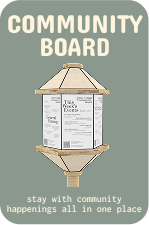
We envision a community board that exists not only to share information, but also as an interactive space in which community members can participate in its creation, share their thoughts and comments, and foster a more profound sense of engagement and belonging through the process of making.
There will be additional community boards scattered around:


THE SHEPHERD
THE LANTERN
THE WATERFRONT
Digital Involvement

Each community board features a QR code that people can scan and be directed to our website.
People can:
ADD to the community board,
SEE what neighbors are saying, and
CHECK out events happening around the neighbourhood.
We provide weekly updated prompts to encourage community members to get involved. They can also message others in the community or post events to promote and advertise their initiatives.


The information on the e-ink interface to change dynamically based on people’s actions on the website.


Data collection
Data collection is crucial to the process as it proves the demand for large-scale infrastructure and the need for permanent social infrastructure.
Our data collection is broken down into three parts:

Vision

We hope the field proves that larger-scale social infrastructure is needed in neighborhood, and that Little Village will eventually migrate from the FOAL to a more extensive, community-centered infrastructure.
bottom of page